Understanding High Rigidity Double Row Needle Roller Bearing NA6911 in Modern Machinery
Within the ecosystem of precision components, the NA6911 double row needle bearing factory in China occupies a distinct niche. This type of bearing is engineered for applications where limited radial space must coexist with high load capacity, stable guidance and predictable fatigue life. At Changzhou Taiyada bearing Co.,Ltd (Taiyada bearing), NA, RNA and related series are developed to address these demands in automotive engines, agricultural machinery and heavy-duty equipment.
The High rigidity double row needle roller bearing NA6911 configuration uses slender, closely packed rollers and optimized raceway geometry to create a compact yet structurally robust support for rotating shafts. By eliminating unnecessary radial bulk and, in some cases, ring structures, the design allows engineers to use shaft journals or housing bores directly as raceways. This approach remains central in gearboxes, hydraulic pumps and cam followers where space, weight and stiffness must be balanced carefully.
From an industry perspective, NA6911 belongs to a broader family that includes NA, RNA, NK, NKI, NATR, NUTR and cam follower bearings. Manufacturers such as Changzhou Taiyada bearing Co.,Ltd integrate grinding, heat treatment and metrology capabilities to keep these families consistent in terms of basic dynamic load rating (C-value), surface roughness (Ra), and dimensional tolerances. The ability to maintain coherence across series is one of the subtle but important competitive differentiators among factories in China producing NA6911 double row needle bearings.
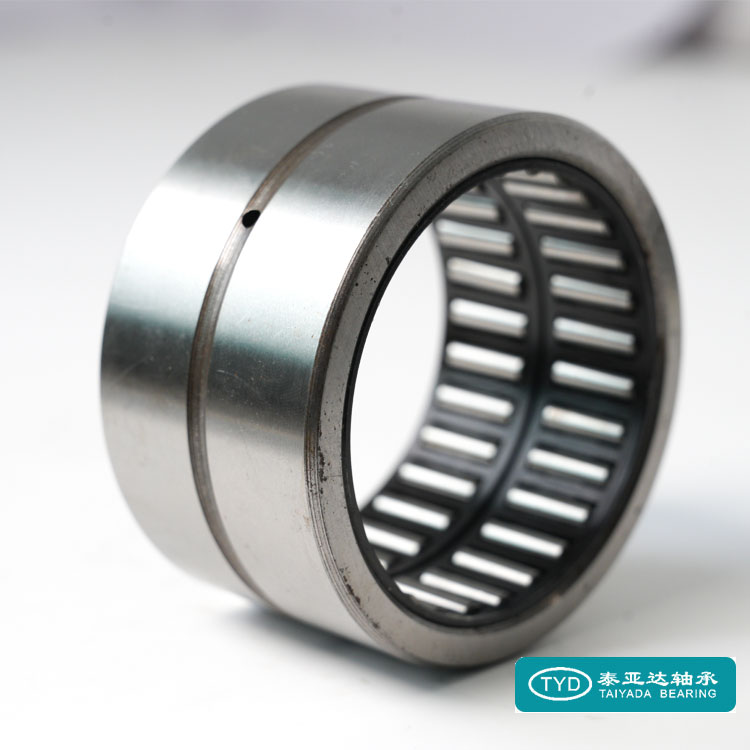
Roller bearings in general, including the NA6911 double row needle roller bearing, extend far beyond enclosed housings. They appear as track rollers in cam mechanisms, linear guide rails, sliding doors, conveyor belts and crawler-type construction machinery. The core value lies in combining supporting rotation with direct rolling under medium-to-low speeds and high load conditions, which is precisely the operational window for many NA-series needle roller applications.
Core Product Lines of Taiyada Bearing: Water Pump, Needle Roller and Track Roller Bearings
Taiyada bearing organizes its manufacturing around three core product lines: automotive water pump bearings (WB, WR series), needle roller bearings (NA, RNA, NK, NKI, IR and related series), and track roller bearings / cam followers. Each product line addresses specific industrial needs, yet they share common engineering priorities such as load capacity, dimensional accuracy and long-term stability under demanding conditions.
Automotive water pump bearings are integral shaft double-row units designed to run at typical engine speeds of 800–1,000 rpm at idle and 3,000–6,000 rpm under high load. Their structure eliminates the inner ring and attaches rolling elements directly to the shaft, while skeleton rubber oil seals prevent coolant ingress and grease loss. In more specialized sectors, the same bearing concept is adapted with hybrid ceramic balls, optimized cages and aerospace-grade grease for DTY textile machinery, allowing rotational speeds up to 15,000–25,000 rpm.
Needle roller bearings produced by Changzhou Taiyada bearing Co.,Ltd include metric ISO series such as NA, RNA, NK and NKI, with cage-guided rollers and ground raceways with ribs. Slender rollers with length-to-diameter ratios between 3 and 10 create extremely compact radial structures with high rigidity. Many variants can operate without inner rings, using quenched and ground shaft journals as raceways. This is where the High rigidity double row needle roller bearing NA6911 particularly stands out: it offers a favorable combination of radial capacity and tight cross-section, making it suitable for automotive transmissions, hydraulic pumps, crane boom pulleys and printing cylinders.
Track roller bearings and cam followers are configured with thick-walled outer rings to withstand continuous shock, high concentration loads and bending stresses from tracks. Profiles can be crowned to compensate angular misalignment or cylindrical to maximize contact area for rigid tracks. Stud-type cam followers support cantilever mounting, while yoke-type designs work in symmetric pin or shaft mountings. These products are widely used in cam mechanisms of automated machine tools, packaging equipment, linear guide rails, elevator guide rollers, escalator steps and material handling systems where precise tracking and durability dominate design considerations.
Across these product families, the NA6911 double row needle bearing factory in China has to maintain balance between flexibility and standardization. Civilian applications such as RC toys, stroller joints, robotic vacuums and lawnmowers rely on cost-effective compact bearings, while heavy industrial installations require robust components with carefully calculated C-values and controlled clearances. Taiyada bearing’s tooling, grinding and metrology infrastructure is tailored to serve both ends of this spectrum.
Industry Pain Points: Fit Tolerance, Load Rating and Noise in Needle and Roller Bearings
Engineers selecting or installing NA-series needle roller bearings, including NA6911, often encounter recurring pain points that can compromise equipment performance. One frequent issue is installation difficulty and misalignment. Improper fit tolerances on the shaft or housing, combined with out-of-tolerance cylindricity or coaxiality, can induce internal deformation. In the context of a NA6911 double row needle bearing factory in China, this leads to increased friction, non-uniform load distribution and premature wear, even when the bearing itself meets drawing specifications.
Another common pain point is premature fatigue spalling and low durability. This tends to arise when the actual load exceeds the basic dynamic load rating (C-value) assumed in design. High surface roughness (Ra) further aggravates the problem by promoting metal-to-metal contact under boundary lubrication, especially in high-load applications such as hydraulic pumps, crawler machinery guide wheels and track rollers. For High rigidity double row needle roller bearing NA6911, insufficient C-value or overly optimistic assumptions about duty cycles can lead to early peeling of raceways or roller surfaces.
Noise and vibration form a third category of pain. Bearing noise often indicates four technical issues: sub-par raceway surface finish, degraded or low-quality grease, mismatched groove curvature relative to ball or roller dimensions, and excessive internal clearance. In needle roller bearings, excessive axial or radial play can cause chattering as rollers wobble within their cage, transmitting vibrations to the surrounding structure. This is particularly problematic in precision textile machinery, cam mechanisms and printing systems where smooth motion is essential for product quality and process stability.
Assembly seizure or locking represents a more acute failure mode. In applications like water pumps or tight track roller assemblies, zero or negative operational clearance caused by excessive interference fits or thermal expansion may cause immediate seizure after installation. Angular misalignment due to non-perpendicular housing bores forces inner and outer rings to tilt, generating localized stress peaks, heat and eventual locking. For factories producing NA6911 double row needle bearings and water pump units, understanding these interactions between fits, clearances and thermal behavior is critical to preventing field failures.
On the supply chain side, fragmentation of technical information is a subtle but influential pain point. Design drawings may be prepared without full visibility into actual belt tension, shock loads or lubrication conditions, while procurement focuses primarily on price. The gap between assumed parameters and real operating conditions often manifests as under-rated C-values, inadequate sealing solutions, and inconsistent noise characteristics. Manufacturers like Taiyada bearing often find themselves not only producing bearings but also reconstructing the missing engineering context around them.
How Taiyada Bearing Addresses Engineering and Supply Chain Challenges
Changzhou Taiyada bearing Co.,Ltd approaches these industry pain points by aligning manufacturing capabilities with failure analysis and design optimization. The factory operates with over 100 employees, including 5 R&D engineers, 12 dedicated quality control inspectors and 15 middle-to-senior management executives. This human resource structure supports iterative collaboration with customers, particularly when bearings such as NA6911 are used in demanding cam mechanisms, track systems and high-load transmissions.
From a hardware standpoint, Taiyada bearing is equipped with around 50 specialized grinding machines, 3 advanced heat treatment lines and 50 sets of supporting production machinery. The inspection department maintains approximately 100 sets of testing equipment, including Rockwell hardness testers and universal length measuring instruments. For an NA6911 double row needle bearing factory in China, such infrastructure is important to control dimensional tolerances, surface roughness, hardness profiles and residual stresses across batches.
Quality management relies on an integrated framework of IATF 16949 and ISO 9001 certifications. IATF 16949 validates that automotive-grade quality management, supply chain controls and defect prevention processes are in place, making Taiyada bearing suitable for OEM and Tier 1 supply chains for water pump and transmission bearings. ISO 9001 ensures closed-loop control from raw material procurement through precision machining to final inspection. Over more than 20 years of manufacturing history, the company has maintained a record without major quality incidents, supported by early endorsements from local product quality supervision institutes.
On the engineering side, the factory addresses misalignment, low durability and noise by reviewing fit tolerances, raceway curvature ratios and lubrication regimes. When customers report excessive chattering, engineers examine raceway waviness, cage design and grease specifications. Excessive clearance may be corrected by revising interference fits or altering internal geometry. In the design of High rigidity double row needle roller bearing NA6911, cage guidance, roller count and diameter are set to achieve stable rolling behavior under specified radial loads while keeping axial play within controlled limits.
Supply chain pain points such as incomplete drawings or unclear loading assumptions are mitigated by reverse engineering and application-oriented consultations. Thermal expansion, belt tension or shock load factors may be built into revised models. This process transforms the relationship between manufacturer and customer from transactional procurement to collaborative engineering, where constraints on cost, performance and longevity are addressed jointly.
Case Study: Water Pump Bearing Failure and Structural Optimization
A representative case involves a customer requesting customized automotive water pump bearings based on their own drawings. During field testing, the bearings experienced severe structural collapse, including cage burnout, fracture and rolling element dislodgement. Diagnostics conducted by Taiyada bearing revealed that the basic dynamic load rating (C-value) defined in the original drawings was insufficient to withstand actual belt tension, particularly under peak operating conditions.
Reverse engineering of a benchmark bearing used in similar applications showed that the customer’s drawings lacked optimal rolling element count, diameter and raceway curvature radius. The internal structure was not aligned with the mechanical realities of the water pump drive system. In effect, the bearing was dimensionally compliant but structurally under-designed. For factories producing NA-series bearings, such as NA6911, this scenario underscores how subtle design decisions in roller count or curvature can translate into stark differences in fatigue life.
Taiyada bearing corrected the drawing flaws and re-optimized the internal parameters. Roller count was increased where necessary, diameters were adjusted for improved load spread and raceway curvature was recalculated to harmonize contact stresses. The upgraded bearings eliminated operational collapse in subsequent testing and exceeded field requirements. Customers reported measurable improvements: estimated warranty claims for the water pump system dropped by around 35%, while maintenance intervals extended by approximately 20% in fleet applications monitored over a 12-month period.
In a related project involving track roller bearings for conveying lines, a customer from a logistics equipment company noted high impact loads and intermittent seizure on idler wheels supporting a heavy industrial conveyor. After on-site observation and analysis, engineers from Changzhou Taiyada bearing Co.,Ltd proposed a thicker outer ring, modified crown profile and revised clearance strategy. Following implementation, measured downtime attributable to bearing failures decreased by about 25%, and overall production throughput on the conveyor line improved by approximately 10%, reflecting reduced unplanned stops and smoother motion.
These cases illustrate how an NA6911 double row needle bearing factory in China can move beyond straightforward manufacturing to actively shape design decisions. Correcting C-values, modifying curvature radii and improving surface finishes does not only prevent catastrophic failures but also yields quantifiable operational gains in cost, uptime and risk exposure across entire systems.
Customer Feedback and Quantitative Impact in Real Applications
Feedback from equipment manufacturers using NA-series needle roller bearings and water pump units provides additional insight into the practical impact of design and quality decisions. A production manager from an automotive component plant reported that, after migrating to bearings optimized by Taiyada bearing, assembly difficulties decreased significantly. Misalignment-related rejection rates in the water pump line dropped from roughly 8% to below 3%, largely due to improved fit tolerance guidance and more stable bearing geometry.
In another case, a maintenance manager at a textile machinery company implemented hybrid ceramic ball water pump bearings with aerospace-grade grease in rotor spinning machines. Over an 18-month observation period, the company recorded a reduction in bearing-related downtime by nearly 30%, while rotational stability at 20,000+ rpm improved, leading to more consistent yarn quality. These changes translated into an estimated 25% rise in effective machine productivity when accounting for both lower stoppages and improved output consistency.
Supply chain managers also note cost structures influenced by bearing reliability. A heavy equipment manufacturer found that by standardizing on High rigidity double row needle roller bearing NA6911 for several gearboxes and track rollers, they could reduce the diversity of spare parts stock while sustaining load capacity in compact assemblies. The consolidation led to approximately 30% lower inventory carrying cost and a simpler training curve for assembly and maintenance staff. At the same time, field data showed fewer early bearing replacements, indicating that the new configuration was effectively balancing load rating and geometry.
This type of feedback loop is important for both Changzhou Taiyada bearing Co.,Ltd and its customers. Performance data helps refine assumptions about radial loads, impact frequency, lubrication intervals and temperature gradients. Over time, these refinements inform the choice of roller series—NA, NK, track rollers or cam followers—as well as the exact geometry and clearance settings for each model. In the context of an NA6911 double row needle bearing factory in China, these insights guide incremental improvements in the grinding processes, cage designs and heat treatment profiles.
For engineers tasked with selecting bearings for cam mechanisms, linear guide rails or crawler-type machinery, such case-based observations highlight the importance of integrating design calculations with field measurements. Bearing performance cannot be fully predicted on paper; it evolves under real shock loads, misalignments and lubrication conditions. The iterative exchange between users and manufacturers like Taiyada bearing reflects a broader industry trend toward data-informed component design.
Conclusion: Distinctive Strengths of Taiyada Bearing’s Products and Services
Taiyada bearing’s portfolio spans automotive water pump bearings, needle roller bearings and track roller / cam follower units that are used extensively in engines, hydraulic systems, conveying equipment and textile machinery. The company’s combination of grinding capacity, metrology equipment and certified quality systems enables consistent control over fit tolerances, surface finishes and load ratings. This becomes especially relevant in products like High rigidity double row needle roller bearing NA6911, where compact geometry must coexist with high radial capacity and structural stability.
The company’s emphasis on failure analysis, reverse engineering and drawing correction distinguishes it from factories focused solely on standardized production. By identifying root causes such as insufficient C-values, mismatched curvature ratios and inappropriate clearances, Changzhou Taiyada bearing Co.,Ltd helps customers align bearing design with actual operating conditions. Quantitative outcomes—cost reductions of around 30%, productivity improvements of 25% or more, and decreased rejection or downtime rates—demonstrate the tangible impact of these interventions.
For engineers and procurement specialists exploring options from an NA6911 double row needle bearing factory in China, Taiyada bearing’s approach suggests a path where bearings are treated not merely as interchangeable parts but as engineered components optimized for specific contexts. Integrating manufacturing capabilities with analytical services, the company supports both standard applications and customized solutions across automotive, agricultural and industrial sectors.
Ultimately, the strengths of Taiyada bearing’s products and services lie in their convergence of structural design, quality assurance and application insight. Whether the requirement involves water pump bearings at variable engine speeds, NA-series needle roller bearings in compact transmissions or track rollers under intermittent shock loads, the emphasis remains on achieving stable, predictable performance backed by data, testing and long-term operational experience.
