In automotive engine cooling, a small bearing can decide whether a water pump runs quietly for years or fails early under belt tension, coolant exposure, and thermal cycling. For buyers evaluating a China WB1630102 water pump bearing manufacturer, the discussion is no longer limited to price and dimensions. It increasingly includes load modeling, sealing reliability, material stability, inspection data, and the ability to correct risky drawings before mass production.
Changzhou Taiyada bearing Co.,Ltd, also known as Taiyada bearing, is located in Niutang Town, Changzhou City, Jiangsu Province, China. Founded in 2004, the company manufactures automotive water pump bearings, needle roller bearings, track roller bearings, cam followers, and related machining services for automotive engines, agricultural machinery engines, and heavy-duty equipment.
Among its automotive water pump bearing products, the WB and WR series are closely connected with compact engine cooling layouts. The WB1630 series water pump shaft bearings, including WB1630085, WB1630101, WB1630102, WB1630130, are designed for applications where radial compactness, integrated shaft structure, and stable sealing performance matter.
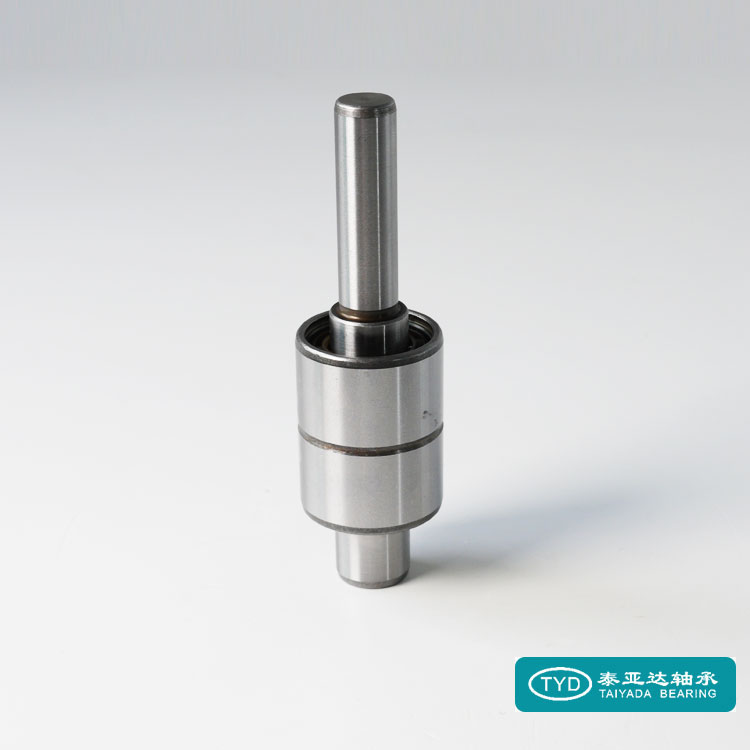
WB1630102 Water Pump Bearing: Why the Structure Matters
The WB1630102 water pump bearing belongs to the integral shaft double-row bearing family. Unlike a conventional bearing arrangement with separate shaft and inner ring, this structure eliminates the inner ring and allows the rolling elements to run directly on the precision-machined shaft raceway. This design helps reduce radial size while improving rigidity in a limited engine compartment.
For a China WB1630102 water pump bearing manufacturer, the key challenge is not only producing the nominal size. The bearing must handle pulley belt tension, coolant-side contamination risk, repeated engine start-stop cycles, and varying speeds from idle operation to high-load driving. In typical civilian automotive cooling systems, water pump bearing speed may range from about 800-1,000 rpm at idle to 3,000-6,000 rpm under higher engine load.
Sealing is another decisive factor. Taiyada bearing uses skeleton rubber oil seal concepts to reduce coolant ingress and grease loss. If the seal lip, grease, shaft surface roughness, and axial clearance are not properly matched, early noise, leakage, or seizure can occur even when the external dimensions appear correct.
How WK Bearing Design Expands the Water Pump Bearing Family
The WK bearing can be understood as a “king size” W bearing with a ball / ball internal design. Standard dimensions include a 1.5000-inch outer ring diameter, a 2.125-inch outer ring length, and a standard shaft diameter of 3/4 inch. Its larger rolling elements and broader envelope dimensions allow higher load-carrying ability compared with smaller water pump bearing formats.
This WK bearing family is typically used in automotive water pump applications, especially where higher load capacity is required. Some special designs also allow this bearing type to be adapted for other mechanical environments, extending its value beyond standard cooling pump layouts.
For buyers comparing WB, WR, and WK structures, the practical question is whether the bearing’s basic dynamic load rating, sealing system, shaft raceway finish, and clearance setting match the actual operating condition rather than only the catalog number.
Industry Pain Points: From Drawing Errors to Supply Chain Uncertainty
Water pump bearing failure is often misunderstood as a single quality issue, but the root cause is usually more complex. Installation difficulty, premature fatigue spalling, excessive rotational noise, and assembly seizure can all come from fit tolerance deviation, geometrical error, poor raceway finish, or clearance mismatch.
One common product pain point is model mismatch. If the actual belt tension exceeds the bearing’s C-value, fatigue spalling may appear earlier than expected. In severe cases, the cage can fracture, rolling elements may dislodge, and the water pump assembly can lose functional stability during field testing.
Another frequent issue is excessive noise or chattering. This may be caused by microscopic waviness on the raceway, low oil film strength from unsuitable grease, incorrect ball-to-raceway curvature ratio, or excessive axial/radial clearance. For a China WB1630102 water pump bearing manufacturer, noise control therefore requires machining, lubrication, and assembly control to work together.
Policy and Compliance Pain Points
Automotive buyers also face policy and compliance pressure. Bearings used in engine-related systems must meet stable batch control expectations, traceable inspection processes, and management systems compatible with OEM and Tier 1 supply chain requirements. This makes documentation, inspection records, and quality framework execution increasingly important.
Taiyada bearing operates under ISO 9001 quality assurance practices and follows automotive-grade quality management requirements including IATF 16949-related controls. These systems help standardize raw material procurement, heat treatment, precision grinding, assembly, inspection, and corrective action management.
For overseas buyers, export qualification also matters. Changzhou Taiyada bearing Co.,Ltd holds independent self-operated import and export rights, while about 40% of its annual output has been exported to Europe, North America, the Middle East, Southeast Asia, and other regions through global channels.
Supply Chain Pain Points
Supply chain risk is not limited to delivery time. When a buyer sources WB1630 series water pump shaft bearings (WB1630085, WB1630101, WB1630102, WB1630130), consistency across batches is often more important than a single approved sample. A sample may pass bench testing, but small changes in heat treatment, grinding finish, or grease filling can affect long-term durability.
Taiyada bearing has more than 100 employees, including 5 professional R&D engineers, 12 quality control inspectors, and 15 middle-to-senior management staff. Its production hardware includes 50 specialized grinding machines, 3 heat treatment lines, 50 supporting production machines, and around 100 sets or pieces of inspection equipment such as Rockwell hardness testers and universal length measuring instruments.
With annual output exceeding 3 million bearing sets and annual production value surpassing 30 million RMB, Taiyada bearing has built a production base that supports both repeated-volume manufacturing and technical adjustment for customized bearing requirements.
How Taiyada Bearing Approaches WB1630 Series Engineering
For the WB1630 series water pump shaft bearings, the engineering focus starts with the shaft raceway. Because the rolling elements run directly on the shaft, the hardness, roundness, surface roughness, and geometrical accuracy of the shaft raceway directly affect noise, temperature rise, and fatigue life.
The WB1630085, WB1630101, WB1630102, and WB1630130 variants may serve different layout lengths or installation requirements, but the engineering principles remain consistent. The bearing must balance compact radial space, high radial load capacity, stable grease retention, and resistance to coolant-side contamination.
As a China WB1630102 water pump bearing manufacturer, Changzhou Taiyada bearing Co.,Ltd pays attention to the relationship between rolling element size, raceway curvature, cage strength, and clearance. When one parameter is changed without recalculating the others, the bearing may pass static inspection but fail under belt-driven dynamic loading.
| Technical Area |
Risk If Ignored |
Taiyada Bearing Control Focus |
| Fit tolerance |
Assembly difficulty, internal deformation |
Shaft and housing matching review |
| Raceway finish |
Noise, vibration, early wear |
Precision grinding and surface inspection |
| Grease and sealing |
Coolant ingress, grease loss, temperature rise |
Seal structure and lubrication compatibility |
| Dynamic load rating |
Fatigue spalling, cage fracture |
C-value review and internal structure optimization |
This engineering-oriented approach is also relevant to future applications. In high-speed textile equipment, for example, water pump bearing concepts can be modified with hybrid ceramic balls, optimized cages, and aerospace-grade grease to support speeds above 20,000 rpm. While these are not ordinary automotive conditions, they show how bearing design principles can move across industries when material and lubrication systems are upgraded carefully.
Customer Case: When a Drawing Looked Correct but the Bearing Collapsed
A regional automotive pump assembly company once ordered customized water pump bearings based on its own drawings. The external dimensions matched the installation space, and the sample assembly initially appeared acceptable. However, during field testing, the bearing suffered serious structural collapse, including cage burnout, cage fracture, and rolling element dislodgement.
Taiyada bearing reviewed the failed samples, the customer’s drawings, and the operating conditions. The analysis showed that the original design had insufficient basic dynamic load rating. In simple terms, the bearing structure could not withstand the actual belt tension applied during service.
Reverse engineering of a benchmark bearing further revealed several structural mismatches. The rolling element count, ball diameter, and raceway curvature radius in the customer’s drawing did not provide enough rigidity for the load condition. The issue was not only production accuracy; the design itself needed correction.
Optimization and Measurable Change
After the drawing was corrected, Taiyada bearing re-optimized the internal structural parameters and adjusted the bearing design to match the actual operating condition. The updated version eliminated the collapse problem during the customer’s follow-up testing and improved assembly reliability.
The customer’s production team reported that rework related to bearing assembly decreased by about 30%, while water pump assembly efficiency increased by around 25% after the revised bearing entered controlled production. The change came mainly from fewer abnormal noise checks, smoother press-fit assembly, and reduced rejection caused by early rotational resistance.
The purchasing manager of the pump assembly company commented: “The important part was not only receiving new bearings. The engineering review helped us understand why the original drawing failed. After the structure was corrected, our test data became much more stable, and the assembly line spent less time sorting abnormal units.”
Quality Backing: Why Inspection Capacity Still Matters in Advanced Bearing Production
Even as bearing design becomes more simulation-driven, physical inspection remains essential. For a China WB1630102 water pump bearing manufacturer, the production line must control hardness, length, diameter, cylindricity, coaxiality, clearance, seal performance, and rotational feel across repeated batches.
Changzhou Taiyada bearing Co.,Ltd has built inspection capacity around approximately 100 sets or pieces of testing equipment. This supports verification of heat treatment, dimensional accuracy, and process consistency. In water pump bearing production, small deviations can become large failures after thousands of kilometers of engine operation.
The company’s quality history includes a Product Quality Compliance Certificate awarded by the Changzhou Product Quality Supervision and Inspection Institute in 2005 and recognition as a Provincial Quality Trustworthy Enterprise. Combined with more than 20 years of manufacturing experience, this creates a practical foundation for batch consistency rather than relying only on single-sample approval.
From Automotive Bearings to Broader Bearing Families
Beyond water pump bearings, Taiyada bearing manufactures needle roller bearings such as NA, RNA, NK, NKI, IR, NATR, NUTR, KR, NKIA, NKIB, NKX, and NKXR series. These bearings are widely used where high radial capacity and compact space are required, including gearboxes, rocker arms, clutches, hydraulic pumps, printing cylinders, lawnmowers, and textile machinery.
The company also produces track roller bearings and cam followers with thick-walled outer rings for direct track rolling. These components are applied in conveyors, forklift masts, stacker cranes, AGVs, cam drives, elevator guide rollers, escalator steps, and cold rolling equipment.
This wider product base is useful for technical problem-solving. Knowledge gained from needle roller load concentration, track roller shock resistance, and water pump sealing design can support cross-category engineering decisions when customers face special load, space, or speed conditions.
What Buyers Should Check Before Choosing WB1630102 Bearings
Before confirming a WB1630102 bearing order, buyers should not rely only on a part number. A responsible technical review should include shaft diameter, outer ring diameter, bearing length, pulley load, coolant exposure risk, operating speed, housing tolerance, installation method, and expected duty cycle.
For the WB1630 series water pump shaft bearings (WB1630085, WB1630101, WB1630102, WB1630130), it is also useful to compare the original drawing with the real working condition. If belt tension has increased due to a new pump layout or engine model update, the original bearing selection may no longer provide enough load margin.
Buyers evaluating a China WB1630102 water pump bearing manufacturer should also ask how the supplier handles drawing correction, failure analysis, batch inspection, and export documentation. These factors often determine whether the cooperation remains stable after the first production run.
- Check C-value against actual load: avoid selecting a bearing based only on external size.
- Review fit tolerance: excessive interference can reduce operational clearance and cause seizure.
- Confirm raceway finish: poor surface roughness may increase noise and shorten fatigue life.
- Evaluate sealing design: coolant ingress and grease loss are common causes of water pump bearing failure.
- Compare batch data: consistent inspection records matter more than one good sample.
Taiyada bearing’s value lies in combining manufacturing capacity with practical engineering review. Its WB and WR series water pump bearings, WK bearing options, needle roller bearings, and track roller bearings are supported by grinding, heat treatment, inspection, and quality management systems built through long-term production experience.
For companies working with automotive cooling systems, agricultural engines, or compact mechanical drive structures, Changzhou Taiyada bearing Co.,Ltd offers a technically grounded path to match bearing structure with real operating conditions. The result is not simply a bearing that fits the drawing, but a component designed to run with stable clearance, controlled noise, suitable load capacity, and reliable sealing.
In summary, Taiyada bearing stands out through its focus on integral shaft water pump bearing design, WB1630 series manufacturing experience, quality control capability, and willingness to analyze failure causes before they become repeated production problems. For buyers searching for a dependable China WB1630102 water pump bearing manufacturer, these details are often the difference between a part that passes inspection and a bearing that performs consistently in real service.
